The Experience is Important
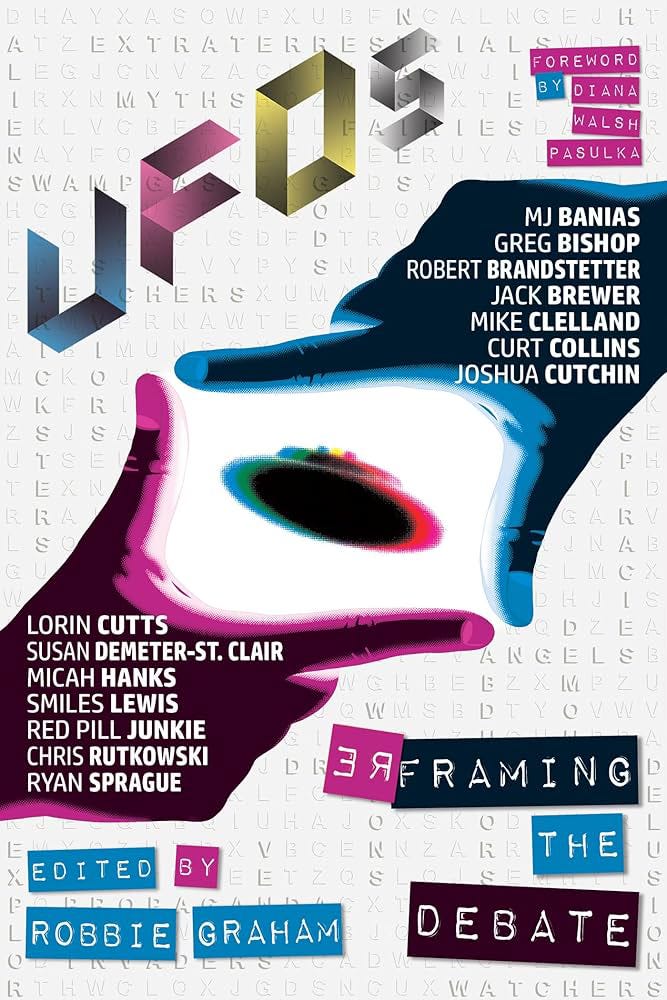
An essay from the 2017 book UFOs: Reframing the Debate

A quick note:
This essay was written nine years ago, and it should feel old, but it doesn’t. It’s just as relevant now, maybe even more so. I was a contributor to this book, along with a bunch of my friends, and here they are:
Greg Bishop, Joshua Cutchin, Lorin Cutts, Susan Demeter-St. Clair, Micah Hanks, Smiles Lewis, Red Pill Junkie (who also did the cover), Ryan Sprague, Diana Walsh Pasulka (who wrote the foreword), and Robbie Graham (the editor).
One more thing, this was initially published in the UK, so I kept their spelling, like pyjamas. I had no idea about that one.
The book is linked HERE
There’s a joke about a guy standing out on the street at night looking down at the pavement under a lamp-post. His neighbor walks up and asks what he’s doing, and he says, “I lost my keys.” The neighbor asks if this is where he lost them, and the guy points to a tangle of thorny bushes off in the darkness, and says, “Oh no, I lost them over there, but this is a much easier place to look.”
In many ways, this is the challenge of the UFO mystery. The pragmatic investigator might want to stay under the brightly lit lamp, yet the core of the mystery is somewhere off in the darkness. Yes, it’s easier to frame the inquiry within the clarity of what we can comfortably wrap our minds around, and maybe that’s a good starting point. But looking into what a UFO might actually be, or what it might mean, is peering through a doorway into madness.
I recognize there’s a need to cling to what can be easily understood. There is a belief that UFO abduction reports can be explained away as little scientists in metal spaceships visiting us to conduct experiments. We get in metal helicopters and abduct grizzly bears in Yellowstone National Park; we tranquilize them, subject them to medical exams, take samples, and then release them—so this analogy is perfect, right? The pilots of those flying saucers are essentially us, just a bit further along their own timeline. This idea, that the UFO occupants are visiting from some other planet, star system or galaxy has been dubbed the Extraterrestrial Hypothesis (ETH), and it has permeated the UFO community to the point that most researchers treat it as certainty.
The problem is that this tidy metaphor falls apart when you really start to examine UFO accounts. It seems the only way to adhere to that simplistic view is to purposely ignore huge swaths of what gets reported. It would seem that we are dealing with something much more bizarre than can be explained by the ETH.
Of all the UFO sightings reported each year, over half can’t be described as anything like a metal craft. Instead, the majority of reports are of ethereal glowing orbs, most often orange in color. People are seeing something that might not be physical at all, at least not in the way we understand it, yet seemingly under intelligent control. The orbs might glow brightly, but won’t illuminate the things around them, as if incapable of projecting light. This is just one point in a long list of things that just don’t make sense.
Granted, visitors from far off planets may play some part in what is happening, but there are weird details that make this seem too simplistic.
One reader of my blog wrote this, and I agree: “I think the reality of what is going on is far stranger than the theories we’ve come up with. I think the idea of extraterrestrials is nowhere near as strange as what it actually is.” This from someone who awoke to a giant praying mantis standing at the foot of her bed.
There are aspects of this phenomenon that challenge everything. The web of little strings seem to go everywhere. Everything is on the table—life, death, sex, dreams, spirituality, psychic visions, genetics, expanded consciousness, mind-control, channelling, mysticism, miraculous healings, out-of-body experiences, hybrid children, personal transformation, powerful synchronicity, portals in the backyard, distorted time, telepathy, prophetic visions, and magic. It’s as if our brains just aren’t big enough to deal with the overload of so much weirdness.
If we start talking about little lights in the sky, it shouldn’t take but five minutes before we’re talking about God. There is something about this mystery that forces us to confront the really big questions. Who are we? Why are we here? What does it all mean? These are the same questions that have followed us through the ages, and they well up again when wrestling with the UFO enigma. I’m always disappointed when a researcher avoids these deeper thoughts, never straying from the safety of that brightly lit lamp-post.
The focus of my obsessive research has been the issues surrounding abduction. There is a reason for this, it’s because I’m an abductee. This is no easy thing to say, and I’m terribly conflicted by what that even means. It’s something that evades easy answers. What I can say with complete sincerity is that something has intersected with my life, and these extremely difficult events point to some form of UFO contact. Coming to terms with this has been a profound challenge and it has altered the direction of my life.
My problem with “ufology” is my own personal experiences. I’ve been at the receiving end of enough weird shit that nobody needs to tell me this stuff is real. For this essay, I am going to mostly ignore all the sighting accounts and focus on what is pertinent to me, the so-called abduction phenomenon.
My other focus is owls, and how they seem to show up, either real or symbolically, in relation to UFO contact. This traces back to my own first hand experiences with owls, lots of them. When I first started seeing owls it coincided with a booming voice in my head that said, “This has something to do with the UFOs!” Their arrival and that message consumed my life. I started collecting stories with both owls and UFOs and it culminated in a 400 page book. This essay will steer clear of owls—there is plenty to be said without opening that can of worms.
Before going any further, I need to state something as clearly as possible—I am not an objective researcher. I am immersed in these dark waters and there is no way to separate myself from the tangled knot of emotions that come with what has happened in my life, things that go way beyond seeing little lights in the night-time sky. So just know, whatever I say is coming from a place of obsessive self-examination, and how it ties into what I’ve heard from others. This would be true for any researcher who has had the direct experience. I don’t know if it’s possible to stay unbiased and detached in a field as highly charged as UFOs.
There has been a series of events peppered throughout my life that seemed to imply some sort of otherworldly contact. As a boy I saw a weird orange flash in the sky while walking home from school and arrived home nearly two hours later than I should have. That same year, I had a close-up sighting of a coffee-can-shaped UFO that vanished in the blink of an eye. As a young man, I awoke to see five skinny big-eyed ‘aliens’ out my bedroom window. I could talk about any of these memories around the dinner table, but they’d be framed as if they were just a funny little anecdote. I have more stories like these, and they all implied something, but I wasn’t going there.
All that changed on Sunday, March 10, 2013. I call this my Confirmation Event.
That night, I was on a lonely road in southern Utah driving home from a UFO conference. Rather than getting a hotel room I simply pulled off and slept out under the stars. It was cold and beautiful, and at some point I awoke to see a giant round structure on the top of a nearby hill. It had a ring of lights around its outer surface and my first thought was, “That looks just like a landed flying saucer.”
I lay there for probably an hour, staring at it. I figured it was nothing more than a big house, and I eventually rolled over and went to sleep. This was the opening salvo in a long set of weird events.
I went back to that spot a year later to see if there really was a big round house on that hill. There was nothing.
The day after arriving home from the UFO conference, while standing next to my desk, I had what I can only call a psychic flash. I clearly saw a map of southern Utah with a straight yellow line running west to east with three points along its length. The image lasted no more than a second, and I immediately sat at my computer and began to create a map to match what I had seen.
I knew the easternmost point was the event from the previous day. I also knew the westernmost point—it was the sight of a terrifying experience in a tent from the spring of 2010. I was camping with a close friend, Natascha, just outside of Dolores, Colorado, and both of us woke up screaming. The next thing I remember was floating up, passing through the top of the tent and arriving in an endless white realm. I awoke in the morning with an eleven-inch scratch across my chest. It looked as if it could have been made by a single rose thorn dragged across my skin. But when examined closely, it wasn’t a scratch at all. Instead, it was a row of tiny fluid-filled blisters all bunched together. I had (and have) no memory of how this could’ve happened.
The site along the center of the yellow line was an event from 2011, again with Natascha. We slept in a secluded spot in the glorious red rock desert of southern Utah, no tent, just lying out on the sand. It was a cold, clear moonless night with a sky packed with glorious stars, and Natascha decided to go for a walk along the dirt road. She hadn’t gone very far when she saw something odd. Her first thought was there was someone with a very bright flashlight out in the sagebrush, but it was moving too smoothly and too low. After a moment, she realized she was looking at a glowing orb of light, maybe two-feet wide. She watched in amazement as it floated towards her, then exploded in a bright flash, and vanished.
Natascha was scared and ran back to our campsite. I’d been lying there awake the entire time she had been gone and I was listening to the loud hooting of a great horned owl, seemingly in the bushes right near my head.
As I created the map on my computer, these three separate events all lined up exactly along a perfectly straight line, 231 miles long. You could zoom in to view the line at one-pixel thick, and it crossed right over the spot in the sand where I had been listening to the owl. The exactness of those three sites along that line changed my life. From that moment on, I could no longer deny what had been happening to me.
There is so much more to this story, and to tell it properly requires about an hour, or over 20 pages (with illustrations) in my book. A flood of other events reverberated outward from this moment of confirmation. Synchronicities, more psychic flashes, number sequences, ethereal floating mandalas, a shamanic ceremony, birthdays, and coyotes, all play a part in this frenetic narrative. It’s impossible to truly describe what it’s like to be swallowed up like this. It’s not just one isolated event, it’s a lot of them, and this barrage can take its toll.
Though imperfect, I’ll be using the term abduction throughout this essay. I’m also using a few other imperfect terms: abductee, experiencer, and contactee. Each of these words might seem interchangeable, but they all imply something different, each having its own conflicting baggage.
Abductee would imply something negative—individuals being taken against their will by UFO occupants. Contactee would imply something positive. Such people might see themselves as being asked to take part in a grand cosmic fellowship. Experiencer, in the middle, is a little more neutral.
There seems to be an induced amnesia created by the UFO intelligences, making the issues of contact terribly difficult to study. Someone might have had a lifetime of repeated experiences, yet remember nothing. These profound events might be buried in the unconscious, yet with impressions that can still influence the person. If so, we should expect some repercussions from these hidden experiences, enough to create personality quirks, like phobias or compulsions.
The word alien is used throughout this chapter, and some object to this because it implies a being from another planet (an assumption). Others prefer visitors, ETs, UFO Occupants, or Star Beings. I know one woman who refers to them only as creatures. The dictionary has several definitions for alien, one of them is: “differing in nature or character typically to the point of incompatibility.” For me, this seems entirely acceptable. Sadly, all these words fall short because none of this is straightforward.
Abduction accounts can be exceedingly complex. A person might remember just little bits of the beginning and the end of an event, with their memories erased between these bookends. They might recall only a fleeting image, or have clear memories of events in their entirety. I struggle because there’s no simple way to sum up the conflicting experiences that get reported.
Some will tell hellish nightmare stories at the hands of their alien kidnappers. Others will tell blissful stories, as if they are communing with angels. I try my best not to weight one side more than the other. Something real is happening. There is both deep trauma and mystical transcendence woven into this phenomenon, and these opposite extremes need to be acknowledged. Ignoring one aspect means wilfully denying part of the mystery. There can be an overlap and blurring between these poles, a disparate gray zone where easy answers seem impossible.
~ ~ ~ ~
Dr. Leo Sprinkle is one of my heroes in this field. This big-hearted man has been actively researching UFO contact for over 50 years, and his biography reads like a checklist of every major event in the modern era of UFOs. He has a Ph.D. in counselling and was a Professor of Psychology at the University of Wyoming.
I sent Leo a copy of my owl book right after it was published, and a few weeks later he sent me a hand written letter scolding me for using the word abductee. I love this man dearly, and my heart sank reading his review. He had been a college professor for decades, and I sensed this role in his feedback. He argued that the better word should be inductee. Induction means being brought to something, while abduction means being taken away. Fair enough, but ‘abduction’ and ‘abductee’ are the words we are stuck with.
Leo told me a wonderful story about a reporter who asked him: “What do you say to skeptics?”
First, he clarified the difference between skeptic and a debunker, “Well if they are truly skeptics that’s one thing, but if they are debunkers I don’t really like to talk to them because they’re no fun (laughs). But if a person is truly skeptical and wants to know how to be involved with UFO research, I say read a thousand reports, talk to a hundred witnesses, have your own experience and then we can really talk.”
The reporter replied, “Oh, I guess the experience is important.”1
Yes, the experience is important, but it’s also messy and confusing. With these experiences come mixed-up emotions and ideas, everything getting filtered through our own fragile psyches, and all the assumptions that come with it. It’s also important to know that Leo has seen strange flying objects at several points in his life and has come forward with his own memories of direct alien contact.
A UFO researcher with abduction experiences is very common. When talking to researchers I will ask if they are an abductee, and more often than not they’ll cautiously share their memories of contact. I’m now at a point where I just sort of assume that most of the researchers in this field are abductees (in my weaker moments I’d say all of ’em are). So what does it mean if most of the people investigating UFOs are abductees? One way to look at it would be that such a defining life event would create an interest in the subject. Or, could they have been zapped with a psychic ray gun that derails their normal life and puts them on the thankless path of obsessive UFO research? On some subconscious level have they been ordered to study UFOs? How many UFO books are the result of this kind of manipulation? I’m wrestling with exactly these questions—I mean, why did I write my book?
If we are trying to reframe the UFO debate, just know that many of the debaters on the stage have probably been abducted. If these experiences are what they seem to be, then it should be no surprise that they can come across like fanatical zealots.
In the summer of 2014, I interviewed the editor and staff of Open Minds, an online UFO news source. The audio interview took place shortly after they ended their paper magazine and switched to all digital content. Alejandro Rojas, Maureen Elsberry and Jason McClellan were full-time UFO journalists, and that seems remarkable given the hostility this topic generates.
The site does an excellent job at covering the mainstream accounts of UFO sightings, and would occasionally cover abduction accounts. The articles on abduction were most often a review of classic cases from decades ago (Betty and Barney Hill, Pascagoula, The Allagash Abductions) or they would cover pioneering researchers such as Budd Hopkins.
I had immersed myself in abduction research and felt the three UFO journalists were barely dipping below the waterline, and avoiding the strangest reports and their implications.
During the interview, I pressed them, telling them they should dig deeper and cover the more bizarre aspects of this phenomenon, especially in connection with abductions. Their response was a polite but firm, “No.” Listening back now, my pleading came across as sort of desperate. It’s awkward to hear me acting so pushy, telling a magazine to change their editorial stance. I was almost, but not quite, rude.
They were unyielding, not wanting to stray from journalism and into conjecture. Maureen said, “It’s almost like mixing religion and news… there’s a fine line with this and it would be difficult to do.”
Alejandro said, “We try to balance this as best as we can… If there’s a mission of ours, it’s to penetrate the mainstream.”2
Listening to that audio interview again for this essay, the anxiety and tension in my voice was clear. There was a neediness in how I was acting, and it was hard for me to hear. I was tempted to edit this exchange from the podcast because I sounded like such an impatient zealot. These were my true emotions, so, although it was awkward, I left it in.
Author, blogger and researcher Christopher Knowles wrote to me afterwards: “I listened to your interview with Open Minds. I think you should realize that at this point the only people who are interested in abduction material are mostly abductees. So I think they did have a point there.”
Yes, but here’s the problem—I feel so strongly about this because I’m one of those abductees.
Within the literature are repeated statements that most abductees feel burdened with a strong sense of mission. I hear this all the time, but I have rarely heard anyone say just what that mission might be. There is something about this that feels so terribly important—it’s like living your life with a flashing red sign that reads “urgency” front and center in your mind’s eye. Adding to this is a burning need to make sense of my experiences, and this angst can get overwhelming.
After my pleas during that interview, Jason suggested I write something for their site. He was right. What I had asked was for them to publish more of the articles that I would want to read. So I sat down at my computer, began typing, and two months later they posted my article with the headline “The Possible Unsettling Implications of UFO Sightings.”3
The ideas in the article came from a series of conversations I’d had with the late Elaine Douglass. She had been with MUFON for 25 years as the state director for Utah and Washington DC, and most of her research had focused on abductions.
While conducting sightings investigations, she would ask the witnesses the standard set of questions—what time, how big, and so on. But she’d follow up with deeper, more personal questions, asking them to describe any unusual personal events. She would ask, “So, what else, in your whole life, has ever happened to you that you cannot explain?” More often than not, a big story would emerge. Many of the witnesses told Elaine about unusual events that might imply some sort of direct contact experiences. Her conclusion, after a quarter century of research, was that over half the people who see UFOs are abductees.
This may seem like a bold statement, but it’s very similar to what other investigators have concluded. Abduction researcher Budd Hopkins spoke openly that if someone sees a UFO, they are most probably either seeing it arrive or leave, and some length of missing time is covering an abduction. The implication being that memories have been erased by the ‘occupants’ of these elusive ‘craft.’ Hopkins also publicly speculated that there are probably more abductions than UFO sightings, a comment that surely rankled the more conservative researchers.
Assuming the role of journalist, I called a bunch of abduction researchers and asked each of them the same question, “What percentage of people who are reporting an unambiguous UFO sighting are actually abductees?” The word unambiguous was included in the question to separate the more close-up structured reports from just little dots of light way off in the distance.
The article quoted five researchers, and although they all felt it was impossible to come up with an actual percentage, most agreed with Elaine’s conclusion. The others were more cautious, yet still acknowledged her point.
When asked the same question, abduction researcher and hypnotherapist Yvonne Smith was quick to agree with Elaine’s conclusion, saying the majority would be abductees. She said, “Many of the close-up sightings will have clues that this was a probable contact experience, things like distorted or missing time, or a car engine sputtering and mysteriously stopping.”
Joe Montaldo is both an abduction researcher and an abductee, and he said, “ET never has to show himself to anybody. There is no need to ever let anyone see a craft, ever.” This implies that their technology is so advanced that making their craft invisible is effortless, meaning if anyone actually sees a UFO it’s because they want to be seen for a reason. When asked to give a percentage of how many people who see a UFO are actually abductees, Joe said, “I’d put it at 100 percent.”
Any of these statements would be terribly difficult to quantify, yet one thing all the researchers agreed on was that the closer the UFO to the witness, the more likely an abduction event has occurred. There is an implication that many, if not most UFO sightings have a buried abduction component.
The thought that most sighting reports might be abductions is more than a little bit disturbing. It’s at odds with how most of us are even capable of thinking about the issue, and this includes seasoned UFO investigators.
My article generated a lot of traffic for the Open Minds site. There was a stat counter that displayed the online hits, and the numbers were quite high. This gave me the sense that there are plenty of people out there eager to read about the stranger aspects to the UFO phenomenon. The only other post I could find with higher hits was an article where Dan Aykroyd recounted his personal UFO sighting.
Early on in my research I had a long talk with Miriam Delicado, someone who would fit the definition of a contactee, a term implying an ongoing communication with benevolent aliens. She has been an outspoken presence, sharing her experiences since the publication of her 2007 book, Blue Star: Fulfilling Prophecy. During that conversation, I asked her what she tells people when they ask about the reality of these experiences, and without skipping a beat she said, “Look at my email inbox.”
In the years since that conversation, I’ve been speaking out about what has happened to me. And now, like Miriam, my email inbox is overflowing with people reaching out to me. They are telling me their experiences, and most of these letters have a desperate tone. I understand this deep need for someone to simply listen.
This journey has been terribly confusing, especially when I first started looking into my experiences. During those initial years I sent out letters just like the ones I’m receiving now. I mailed them off to the researchers and experiencers who I thought might be able to offer help. What I am receiving, for the most part, is coming from abductees. Even if they don’t say it, their stories certainly include the clues and events that imply a hidden abduction experience. I read their accounts, try to offer some kind words, answer their questions, and then new ones arrive.
Each of these stories should be investigated, yet that isn’t happening. Just from the number of emails I receive, I can declare this phenomenon is much more pervasive than anyone would dare consider. Yet, there isn’t the money, manpower, or time to truly deal with the magnitude of what is being reported.
At the heart of each account is a real person, and in many cases a family who are struggling with something beyond comprehension. It’s one thing to catalogue the reports and compare the details, but it’s something altogether different to try to come to grips with what it all might mean. Any attempt to reframe the UFO debate requires a deeper awareness that these experiences are terribly complex and deeply personal.
There are a lot of subtle (and not so subtle) clues that imply abductions are something widespread and common. If this is true—and from my point of view it certainly seems to be—shouldn’t it be considered important?
UFOs are not ambiguous, they are a part of us, they are interwoven into our human consciousness. But what does this even mean?
The word consciousness has become a sort of catchphrase for anything that might deal with the mind, or perhaps the higher mind. Telepathy, psychic weirdness, collective memories, spiritual awakenings, and divine transformations all get lumped into the big consciousness basket. I’ve heard established UFO researchers being warned by their peers not to go down the path of consciousness. Better to stick with the pragmatic details, like government documents and reports from credible witnesses. The fear is you’ll lose all credibility by even considering anything so intangible.
Anything seen as new-agey gets ignored by those who want to cling to something tangible, things like metal spaceships. The more ethereal aspects are swept aside for fear of “turning off” the greater public. Better to frame it as something easier to wrap your mind around.
Another reason this weirder stuff gets ignored is some folks feel a need to be taken seriously. I would love to be taken seriously too, but I also feel a need to honestly share what’s happened to me.
I have spoken to a few abductees who are out there telling their stories in a very public way. They keep to their script, and what they share is both remarkable and strange. But, when I take them aside and ask if anything else is going on, they will whisper something extremely bizarre—I mean like really freaky shit. When I ask why they don’t share that part too, they’ll say they need to be taken seriously. I get this, yet the dilemma remains. Much of this phenomenon is just too outlandish to even bring to the table.
While at a UFO conference, I spoke briefly with journalist Lee Speigel, he covers (among other things) UFOs for The Huffington Post. I asked him why I never see any articles about abduction in his reporting. He told me that he doesn’t want to write anything that would “turn off” the readers. The way he said it was very matter-of-fact and practical.
Moments later I spoke with filmmaker James Fox. I asked him if his upcoming feature-length UFO documentary would include anything about abductions. He pretty much gave the same answer, “No, we’ve decided we want to be taken seriously, we don’t want to lose our audience.”
I’ve heard this a lot. Journalists, authors, or filmmakers who specialize in UFO reporting will shy away from the topic of abductions. Or, if they do cover it they’ll only reference events that are decades old, like Betty and Barney Hill.
The problem with the abduction subject is that it seems to have two layers. The surface layer is what we’ve all seen on late-night cable TV documentaries—creepy gray aliens taking people from their cars on lonely roads. The deeper layer is much more challenging. Things become absurd, as if the mystery of consciousness has been jumbled up with alternate realities and mythic imagery. This is obviously a simplistic way to look at it, and the whole thing probably goes ten layers further down. Hardly anyone wants to address that surface layer, and pretty much nobody wants to go any deeper.
Anne Strieber, the late wife of author Whitley Strieber, had a simple way of evaluating the validity of a UFO contact report. She said, “If it’s not weird, I don’t trust it.” She called this little phrase her BS detector. Author Nick Redfern has said something similar. When trying to describe the complexities of UFO research, he says “It’s not just that it’s weird, it’s too weird.”
This is what I’m drawn to, the accounts that are so weird they defy any logical explanation. I’m pulling on this thread because it’s been my own direct experience.
Within these stories is a confusing collision of overlapping experiences, a mess of twists and turns, and the details are absurdly weird. Things feel mixed up with threads running off everywhere and synchronicity spills over the edges like an unattended sink. For me, this kind of chaos is a sign to trust the event as legitimate. The more complicated and irrational the interwoven details, the more valid it seems. For me, this is a shaky form of proof, but proof of what?
I’ve been using the term paradox syndrome to describe this frenetic pattern. A paradox is an attempt at sound reasoning, but the conclusion appears unacceptable. A syndrome is a group of related or coinciding things, events, and actions. I don’t understand why it works this way, but all the messy threads must tie into some core event, and the challenge is to not get lost in the mayhem. I’ve been collecting and cataloguing precisely these kinds of stories. My own Confirmation Event, told earlier, is one of those stories.
If we are trying to reframe the debate, we need to be aware that these more complex accounts are not easy to categorize or share. It takes a great deal of patience to sit and listen to what people have been through. The bar is set pretty high for what I consider too weird, yet I’ve met plenty of people who tell me stories that stretch what I can fathom. It would be easy to dismiss these folks as unreliable, but I feel strongly that there is a need to listen to their experiences.
I spoke to a researcher with a focus on sighting reports and he told me, “I used to do abduction research, but it just took up so much time.” My heart sank when he said this, yet what he said seems fair. It’s easier and less time-consuming to study UFO sightings than to get dragged down into the bottomless pit of abduction research.
I had a friend call me out on how I do my research, he was frustrated and said I wasn’t being scientific. My response was “What do I care, I’m not a scientist.” He was right by pointing out that I’m not objective. I’m not trying to approach this muddle of divergent experiences with science as a tool. Instead, I see my role as more of a folklorist. I’m simply collecting stories and letting these narratives speak for themselves.
There are cries that the UFO phenomenon should be studied scientifically. Perhaps it should, but that isn’t my concern. The scientific community has either ignored or denounced the UFO phenomenon for close to 70 years. With very few exceptions, the people who try to wrestle with this mystery using any kind of scientific rigor end up framing it merely as metal spaceships from another planet. They want to measure burn marks in a farmer’s field. They don’t want to cloud their tidy documentation with the strange invasion of consciousness that gets reported when you listen carefully to what experiencers are saying. These challenging stories are being lived by real people, and I sense an even deeper story hidden below the water line.
To examine this subject rationally seems tenuous, so I’ve been putting more of my efforts into trying to read the symbolic clues. I’ve come to see these experiences playing out with a sort of dream logic. Instead of looking to a pragmatic UFO investigator for answers, it might be better to ask the gypsy fortune teller.
At this point, I see the skills of a dream interpreter being an appropriate tool when analyzing someone’s experience. Scrutinizing reality as if it were a dream has become normal for me. This kind of thinking probably puts me on the “outs” with most of the mainstream researchers, but I can’t help it. This is an esoteric mystery and it requires esoteric methodologies to peel back its secrets.
If you see a UFO, is it better to call a MUFON investigator, or the local shaman from the nearby Indian Reservation? The no-nonsense investigator will ask what time you saw the object, and to describe what it looked like. The shaman might ask very different questions. What has been going on in your spiritual life leading up to your sighting, and what has changed in the aftermath? He might inquire about dreams, premonitions, gut feelings, and intuitions.
This is not a call to dismiss the role of the nuts and bolts investigator. There is a responsibility to walk out into the witnesses yard and measure the burn mark in the grass, then write that down in your notebook so it can be compared with other cases. This is an important part of the overall process. But it’s equally important to look beyond the physical clues. We need to ask the witness how their soul has been influenced by what they’ve experienced—and then pay close attention to the answers. We are dealing with a phenomenon that can seep its way into our reality in ways that are both outlandish and profound. My advice to any new researcher would be to expect absurdities and to trust their gut.
Leo Sprinkle spoke with me about his own journey, from UFO researcher to an instantaneous knowing that he was himself a UFO experiencer. It happened in a group meeting where he listened to a witness describe the uniform worn by an alien being—the pants had feet connected, like a child’s pyjamas. He was hit with a flood of memories and was suddenly sobbing. One of his patients said, “Good, now Leo is suffering like the rest of us!”
Suffering with these experiences is entirely accurate. Leo described the challenges of coming to terms with this realization. He said: “It was a long journey, but finally I accepted that I was on the path, and the way to follow that path is to not only be conscious of what is happening at the head level, but also to be accepting at the heart level or the intuitive level.”
This is good advice for self-examination, as well as for looking at the overall contact phenomenon. Many of the people involved have endured something traumatic, and they need help as well as compassion.
Jeffrey Kripal is a historian of religions, and a professor of Philosophy and Religious Thought at Rice University in Houston, Texas. He is the author of multiple books on the mystical experience, including The Super Natural which he co-authored with Whitley Strieber.
Jeff has studied ancient manuscripts and also worked with people who tell of their own anomalous experiences. These might be religious epiphanies, or a UFO contact event. In the quote below Jeff describes what I’ve encountered many times. He clearly articulates the challenge of listening to people as they share what has happened to them, and the deeper challenge of making sense of these stories.
This is the thing about this material, you think you’ve heard the last strange thing, and then it gets stranger. What the debunker [rationalist] thinks is that, no—if we just had enough information it would all make sense and all the strangeness would go away.
But my experience with these folks is exactly the opposite. The more they tell you the weirder it gets. Part of the reason is that they don’t quite trust you in the beginning, so they tell you just sort of the surface of the story. And then they tell you a little more, and a little more. And the more they tell you the stranger it gets. It does not make more sense, it makes less sense. And I think that this is important, I think that is part of the phenomena, that it’s absurd, and that it’s meant to confuse us. And I think that when we look for it to make sense I think we are going down the wrong path. Because it doesn’t.4
I understand this in my bones, because I have lived it. Seeing a UFO on a clear starry night is just the smallest part of my story. There is so much more. Coming to terms with what I’ve been through has required abandonment. I was desperate for a pragmatic answer, but any hope of that has stayed out beyond my reach. It floated away and disappeared. I had to give up, and in doing so I’ve reached a place of calmer waters. I’ve had to leave the comfort of that brightly lit lamp-post, step off the pavement, climb into the thorny bushes, and be content in the darkness. In many ways, this describes the owl, a creature at home in the dark.
After the publication of Communion in 1987, Whitley Strieber received a flood of letters, this in an era where people wrote on paper and mailed them in envelopes. His wife, Anne, spent the next few years reading upwards of a quarter of a million of these letters. What she read were heartfelt accounts sent by people describing their own contact experiences at the hands of alien visitors.
Mr. Strieber, I’m scared. After this happened, I felt like I had been standing on bedrock, and that it had dropped out from under my feet, leaving me floating in an ocean whose bottom I could not see. I felt as if everything I thought I’d been clear about for seventeen years—the things that people learn—were lies, and that this was what was important. But it scared me, and I wasn’t sure that I wasn’t crazy. I in fact tried to commit suicide because I didn’t want to be a lunatic.5
This kind of personal testimony is common, I’ve heard it often. These experiences can be horribly traumatic. Even the good experiences will leave people adrift without any easy way to deal with the sudden disappearance of their sense of reality. Your old way of thinking crumbles, and then something new needs to be rebuilt to take its place.
~ ~ ~ ~
In order to honestly address the contentious issues surrounding Disclosure, I need to confess what I have done. I have eaten Stephen Bassett’s ice cream without his permission. For anyone who doesn’t know, Bassett has been at the forefront of the UFO disclosure movement. He has worked for over a decade to force this issue into the public sphere. Now more about the ice cream. I was on a road trip in the desert southwest on the way home from a UFO conference in Phoenix. I was on a stopover for a few days, staying on the floor of my close friend Kim Carlsberg’s house in Sedona. She wrote about her abduction experiences in the 1995 book, Beyond my wildest Dreams.
During my short visit, Stephen Bassett was staying in the guest cabin in the backyard. All of us had a chance to hang out during my visit, and, I have to say, Stephen is an enormously likable guy. He’s quirky and passionate in a way that’s wonderfully engaging. I came in one of the nights during this visit when nobody was home, I peeked in the fridge and saw a pint of chocolate almond ice cream, and I knew it was Stephen’s. I was confronted with a moral dilemma. In that helpless moment, I got a spoon, took a large scoop and ate it down. It was delicious.
I needed to make that confession before the next part.
Even though I like Steven Bassett, the one corner of this field that I try to steer clear of is Disclosure with a capital D. Sorry, I just don’t have the patience for it. These issues seem to float out beyond what I’ve been focusing on in my research. It’s like hearing muffled music coming through the walls from the neighbor’s apartment, and I do my best to ignore it.
I’ve seen UFOs, and I feel pretty damned certain I’m an abductee, and with that comes the absurd aftermath that makes normal life near impossible. I don’t need anyone on a podium to tell me something I already know. I don’t need someone in authority to validate what I have struggled to come to terms with on my own. And I certainly won’t wait for some kind of approval. Fuck all that.
For me, I see there are three kinds of disclosure. The first is unlikely—the whole world watches a press conference on TV where the President states that UFOs are real. This is what people want to envision when they try to imagine disclosure. This seems simple enough, but what happens when the first question asked by a reporter is, “So what about all those people who say they’ve been abducted from their bedrooms at night?” I just don’t see this ever happening.
The second is that “they” show up in a way that is absolutely undeniable. Imagine waking up to the news that fleets of alien motherships are parked over all the world’s cities. Maybe that will happen someday, maybe even tomorrow morning. For me, this has already happened. I’ve already suffered through that realization, and this sometimes gets referred to as the trauma of enlightenment.
The third kind of disclosure isn’t as exciting, it’s a slow steady change in beliefs. People hear others whispering about what they’ve seen in the sky, and those accounts eventually turn to acceptable dinner table conversations. Little by little, stories of abduction change from being dismissed to being accepted— perhaps they will never be fully accepted, but will at least be considered. We are at a point where everybody has a smart phone, and sightings are easy to record and these experiences are easily shared on the internet. One day, all of us sort of realize this is really happening. Nobody needs to ring a bell to declare the momentousness of this day, it just becomes self-evident.
Richard Dolan is a historian and author. He wrote a book with Bryce Zabel titled A.D. After Disclosure, where many of these ideas are addressed. Dolan describes the inherent conflict within this issue:
I’ve often felt that disclosure on the matter of UFOs and possible ETs is a paradox. It is impossible, but it is inevitable. Impossible because there is no political motivation for it. Period. Inevitable, however, because our leaders are not the only factor in the equation. There are the other beings, after all. But mainly, there’s us. The People. Who are going through the greatest social, cultural, and especially technological transformation in the history of humanity. In fact, we are the game changers.6
Richard says it’s inevitable; that we are the game changers. So what does that mean, and what are we supposed to do?
When people imagine Disclosure, they want a nice British actor with a deep voice stepping from his shiny flying saucer like that scene in The Day The Earth Stood Still. I’ve spoken to hundreds of abductees, and never once have I heard them describe seeing an alien walk out of a landed craft (that said, I’ve read some accounts like that, but very few). What I have heard is countless descriptions of little beings simply stepping through a swirling vortex in their bedroom wall. This is something rarely mentioned under that lamp-post. Their arrival might not be in a fleet of motherships like in the movies. Instead, they might just suddenly be standing in our bedrooms.
Whitley Strieber wrote: “To my mind, if the visitors ever come, it will not be a landing at all, but something more like the removal of a wall that now exists between our worlds. What will happen to us then is that we will suddenly start living by new laws of reality. I suspect that many, many of us will not survive the transition in anything like a normal or coherent mental state.”
If disclosure (with a small d) ever happens, it will happen from the bottom up, not the top down. There are statistics about how many people believe in life on other planets, or if UFOs are real, and the numbers are startling. A 2013 poll from the Huffington Post reveals that 48 percent of adults in the United States are open to the idea that alien spacecraft are observing our planet, and just 35 percent outright reject the idea.7
This is all well and good, but what I’ve never seen are any statistics that stray beyond the ETH assumptions. What if statisticians asked, “Do you believe aliens from another dimension are entering into our reality, and tapping into our consciousness?” That would be difficult to answer by checking a yes or no box on a questionnaire. We are only getting a fleeting glimpse of something beyond the cosmic curtain, and the disclosure advocates want it to be like Star Trek.
Within some corners of the abduction community Disclosure is seen not as any kind of proclamation from the government, but an Arrival with a capital A. Basically, ‘they’ will be here. And not just an upswing in UFO sightings—we will share this planet with them. I’ve heard this predicted within abduction accounts, and I know plenty of people who are eager for the day we join the Galactic Federation. This is now a kind of modern folklore having arisen out of the hopes of true believers, but I’m not holding my breath.
There is no way to predict the future. Nobody knows how any of this will play out. I have no interest in asking to be told what I already know. I am not sure what my role is supposed to be in the big grand drama of UFOs. All I can say is that it’s hard work with very few rewards.
I am no longer in a position to wait for other people to make ripples in this pond. It’s my job to say what I feel in my heart, and to do it in a way that it will be heard.
This is an arena that a lot of people will ignore, or dismiss with contempt. Simply talking about these ideas is considered crazy in the eyes of many.
There is a need to be brave. Mythologist Joseph Campbell wrote about the challenge of the inner quest: “You enter the forest at the darkest point, where there is no path.” He was referencing the Knights of the Round Table as they embarked upon their quest for the Grail. The UFO subject is just a long list of unknowns with no path to follow. But you can still press on in the darkness.
I really have no idea what is happening and what it all might mean, my thoughts change with the wind. What I feel strongly on Monday fades away on Tuesday, replaced by some new perspective on Wednesday. Ideas form, shape up into something viable and then collapse. We are confronted by a genuine mystery, and nothing would be more gratifying than to actually solve it. But I don’t expect that to ever happen.
Everyone is fragile in their own ways and we all bring our own baggage to the table. Trying to grapple with these ideas only reflects some deeper aspect of ourselves back at us.
The reporter who spoke with Leo Sprinkle was right when he said the experience is important—it has the power to change you.
This is a deeply personal journey, and it feels like a mistake to depend on others for their approval. There are times when I feel like I’m chasing my tail, stalling out, or just plain overwhelmed. Yet I wallow forward, trying to make sense of the madness. There is something about this stuff that feels important, and I don’t know how else to say it.
It’s not my job to remedy problems in the UFO community, but it is my responsibility to proceed onward doing the best work I can possibly do. This is hard work, and the hardest of all is looking inward.
A note from the author:
What I shared here might not have been the final edit from back in 2017. There were enough typos that I realize this was a work-in-progress (I remember Robbie nix’d the part about eating Steven Bassett’s ice cream). I went back through and cleaned it up. It was curious to hear myself, nine years later, being so forthright. Yet, I stand by everything I said.
Peace and strength,
Mike!!
audio interview with Dr. Leo Sprinkle, Hidden Experience podcast, Jan. 5 2011, -
Audio conversation with the crew from Open Minds, - Hidden Experience podcast, June 4, 2014 -
Mike Clelland, The Possible Unsettling Implications of UFO Sightings, July 30, 2014 http://www.openminds.tv/possible-unsettling-implications-ufo-sightings/29256
audio interview, Where Did the Road Go, Jeffery Kripal, May 28, 2016, time count 42:30 - http://www.wheredidtheroadgo.com/show-archive/2016/item/290-jeffrey-kripal-on-the-super-natural-part-1-may-21-2016
Strieber, Anne; Strieber, Whitley (2016-06-21). The Communion Letters (Kindle Locations 2457-2459). Crossroad Press. Kindle Edition.
Citizen Hearing on Disclosure, Richard Dolan, May 3, 2013, http://richarddolan.tumblr.com/post/50500962051/dolan-chd-statement-6-disclosure
48 Percent Of Americans Believe UFOs Could Be ET Visitations - article by Lee Speigel - http://www.huffingtonpost.com/2013/09/11/48-percent-of-americans-believe-in-ufos_n_3900669.html
Mike, this is an excellent presentation of the weirdness of The Phenomenon, which you delve in such wonderfully detail in your owl books. At least one of my siblings, possibly more (including me perhaps) was abducted. Hence, my long term interest in UFOs and abductions. I recall how deeply I was affected by seeing the Grey featured on the cover of Whitley’s “Communion” book in 1998. No one really knows what’s going on, but aliens from other planets abducting us for whatever reason—this is probably the least disturbing, because it can somehow be understood within the existing materialist perspective. All that woo-woo stuff that accompanies experiences—this is so very much unwelcome, even by UFO buffs, not to mention “legitimate authorities.” Keep up the good work!
I commiserate with anyone who despairs about the possibility of ever being taken seriously, let alone believed. A friend came up with a term for those of us living lives with high strangeness: the rolling ball of weirdness. I no longer need to tell people what happened. The neediness just dropped away. So many people are coming forward now to speak their truths. I think society, by and large, will accept the reality of UFO's in the very near future. The drama will be over meaning making. It's going to be interesting.